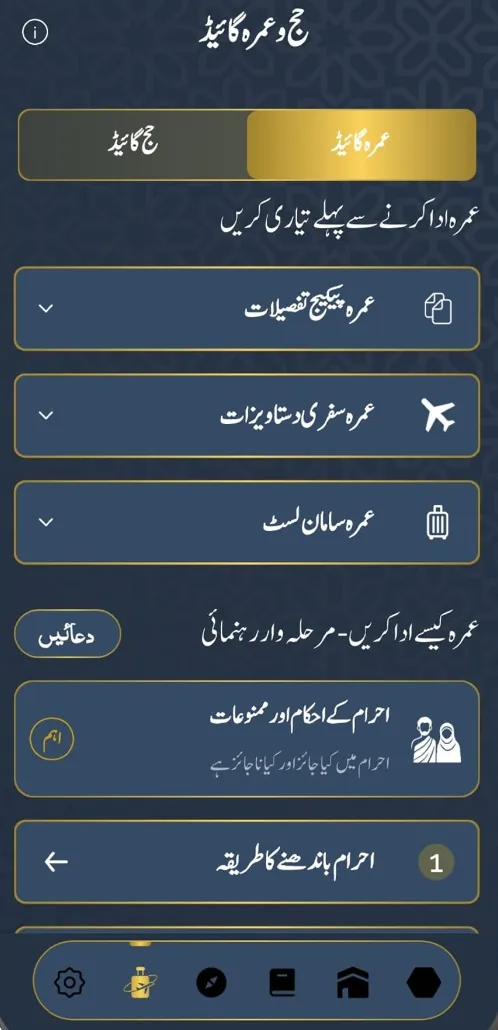
Umrah is sometimes called the lesser pilgrimage, but for anyone standing in front of the Kaaba for the first time it never feels small. This guide walks through each stage in order, so that on the day you can focus on worship rather than worrying about what comes next.
Before you travel
Umrah begins long before the Miqat. Make a sincere intention, settle debts and seek forgiveness from people you may have wronged. Learn the steps and the main duas in advance — reading them a few times at home makes them feel familiar when you are tired and surrounded by crowds.
On the practical side, check the current permit and visa requirements. Umrah permits are currently issued through the official Nusuk platform, and the rules can change between seasons.
1. Ihram at the Miqat
Ihram is the sacred state a pilgrim enters before crossing the Miqat — the boundary points around Makkah. Before Ihram it is sunnah to take a bath (ghusl), trim nails and remove unwanted hair, and men may apply fragrance to the body (not the Ihram cloth).
Men wear two unstitched white sheets: the izar around the waist and the rida over the shoulders. Women wear modest, ordinary clothing that covers the body, leaving the face and hands uncovered. Then make the intention for Umrah and begin the Talbiyah.
لَبَّيْكَ اللَّهُمَّ لَبَّيْكَ، لَبَّيْكَ لَا شَرِيكَ لَكَ لَبَّيْكَ، إِنَّ الْحَمْدَ وَالنِّعْمَةَ لَكَ وَالْمُلْكَ، لَا شَرِيكَ لَكَ
Here I am, O Allah, here I am. Here I am — You have no partner — here I am. All praise, grace and sovereignty belong to You. You have no partner.
If you are flying, the aircraft may cross the Miqat well before landing. Many pilgrims change into Ihram at their departure airport and make the intention when the crew announces the Miqat.
2. Restrictions of Ihram
While in Ihram, a pilgrim avoids cutting hair or nails, using perfume, marital relations, hunting, and arguing. Men do not cover their heads or wear stitched, fitted garments; women do not wear the niqab or gloves. Keep your tongue busy with the Talbiyah and dhikr.
3. Tawaf around the Kaaba

On entering Masjid al-Haram, stop the Talbiyah and begin Tawaf at the line of the Black Stone (al-Hajar al-Aswad). Face it, raise your right hand towards it and say Bismillah, Allahu Akbar. Walk seven circuits anti-clockwise, keeping the Kaaba on your left.
For men, it is sunnah during the Tawaf of Umrah to uncover the right shoulder (idtiba’) and to walk briskly in the first three circuits (raml) where space allows. There is no fixed dua for each circuit — speak to Allah sincerely, in any language. Between the Yemeni Corner and the Black Stone it is sunnah to recite:
رَبَّنَا آتِنَا فِي الدُّنْيَا حَسَنَةً وَفِي الْآخِرَةِ حَسَنَةً وَقِنَا عَذَابَ النَّارِ ﴿٢٠١﴾
Our Lord, give us good in this world and good in the Hereafter, and protect us from the punishment of the Fire.
4. Two rak’ahs and Zamzam
After the seventh circuit, cover the shoulder again and pray two rak’ahs behind Maqam Ibrahim if possible — or anywhere in the mosque if it is crowded. Then drink Zamzam water and make dua.
5. Sa’i between Safa and Marwah
Go to Mount Safa, face the Kaaba, praise Allah and make dua. Then walk to Marwah — that is one lap — and back to Safa for the second, completing seven laps and ending at Marwah. Men jog lightly between the green lights. Sa’i commemorates Hajar’s search for water for her son Isma’il.
6. Halq or Taqsir
Men either shave the head (halq, which is more virtuous) or shorten the hair evenly (taqsir). Women cut a fingertip’s length from the end of their hair. With this, Umrah is complete and the restrictions of Ihram are lifted.
Common mistakes to avoid
- Crossing the Miqat without Ihram.
- Starting Tawaf away from the Black Stone line, or counting circuits inaccurately — if in doubt, take the lower number.
- Pushing or harming others to touch the Black Stone. Pointing towards it is enough.
- Cutting only a few hairs instead of shortening the hair evenly.
Carry the steps with you
Crowds, fatigue and patchy mobile signal inside the Haram make it hard to look things up. The Ziyarat-e-Haramain app keeps the full Umrah guide — every stage with its dua in Arabic, Urdu and English — available offline on your phone.